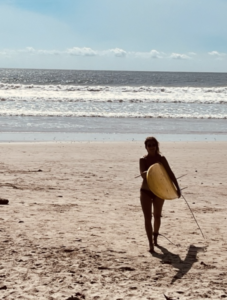
Costa Rica Surfing

Costa Rica Surfing

Over the past twenty years, Costa Rica has become known as a destination for amazing surfing. Costa Rica has two coasts… on the Pacific and the Atlantic, with epic breaks on both of them. The most consistently great surfing is on the pacific coast, with great waves rolling in 99 out of 100 days, from storms all around the Pacific. Surfing areas such as Santa Teresa & Malpais, Nosara, Dominical/Uvita, and Playa Negra have great waves nearly any time of year, with warm water and and exotic jungle backdrop.

Epic waves such as Pavones and Witches Rock have been featured time and again in surf videos, attracting the attention of the surfers around the globe, and so Costa Rica has become an important stop in the surf circuit. According to the country’s travel and tourism statistics, over one million visitors come to Costa Rica every year for surfing. Many have bought property and have moved here, or at least hope to one day, and nearly all of Costa Rica’s beach towns have developed a vibe and culture with the surf lifestyle as a key component.

Categories: Surfing | Tags: , , , , | Leave a comment

Yoga in Costa Rica

A new trend into vacationing nowadays is the consideration of the travellers’ health and well-being. More and more people are getting health-conscious and alternating their lifestyle such as daily work habits and daily diet. Extending these positive changes in lifestyle, more people have also changed the way of their vacationing.

Health-conscious people have slowly started changing their vacations from shopping sprees and lounging around the beach to a healthier option such as spas and fitness retreats. Tourism-driven countries such as Costa Rica have noticed this trend and offer this new alternative to its visitors. Vacations at Costa Rica are known for giving their tourist their much-needed relaxation and rest. Aside from the water sports and beautiful beaches, Costa Rica provides sanctuary and peace through the form of Wellness centers.

One of the nature retreats popular in Costa Rica is called Yoga retreats. These retreats offer tourist the option to learn and perfect the art of Yoga and not simply just to indulge in the culture and beauty of the country. A Yoga retreat is a program designed to teach yoga and imbibe its principles to the participant. The programs also teach the participant to immerse himself to nature and re-learning to appreciate its beauty. Each program is conducted by a professional yoga teacher.

Yoga refers to the physical, mental and spiritual healing disciplines. It has aimed to improve health through the strengthening of the man’s physical and mental attributes. Various benefits have been recognized including improvement of posture, increasing of immunity and decrease of anxiety and depression. For some, it is also practiced for spiritual healing and personal journeys or self-discovery. Spiritual healing can be achieved since Yoga is related to Hinduism and Buddhism. Yoga is also considered as a meditation practice which is a key to one’s personal journey and self-discovery. Hatha, Karma, Dream and Iyengar Yoga are some of the different types of Yoga.

Each Wellness centre is located in the beautiful and secluded terrains of Costa Rica. It is perfect since Costa Rica’s rich biodiversity helps in connecting each participant to nature. Also, the stress and pollution of the city life is left behind so the participant can fully enjoy nature’s comforts.

Different yoga styles are taught by the numerous Wellness centres in Costa Rica. The Hatha yoga (which is gentle) is available in AmaTierra Retreat which is located in San Pablo de Turrubares, Costa Rica. It is a quiet and serene centre nestled in the mountains. Vinyasa Flow is offered in the Wellness centre named Shodhana, which means cleanlines. It is located in Sabana Norte.

Nosara Yoga Institute is located near the Pacific coast. Travelers can enjoy the beach along with their spiritual and physical journey with various professional yoga educations that can help in the improvement of a person’s well-being.

Costa Rica is not only a host to the typical vacation activities that can be done on its magnificent mountains and beaches. The country’s tourism also offers a personal and deep-level journey into self-improvement via its wellness centers.

Categories: Costa Rica Activities | Leave a comment

Scuba Diving in Costa Rica’s Warm Waters

Costa Rica Scuba Diving is a famous recreation activity in the land of the “Rich Coast”. Costa Rica is known for its tropical jungles, picturesque beaches and rich biodiversity. The country is also known for their different dive sites. A wide range of marine life can be explored and experienced in each different dive site. Costa Rica has the Cocos Islands, The Bat and Catalina Islands and Bajo del Diablo—all offering to experience the wonders of the naval worlds.

The Cocos Islands is already well-known and is actually considered as one of the top ten best dive sites in the world. It is an unpopulated island off the coast of Costa Rica. It is located in the Pacific Ocean. Its National Park is acknowledged as a World Heritage Site back in 1997. Apart from that, the Cocos Islands were considered to be part of the new Seven Wonders of the World last 2009. It is home to moist tropic forests and reptiles such as the anole and the gecko.

What’s special about the Cocos Islands in the realm of scuba diving is the marine life it houses. The island is home to the different turtles, humpback whale, dolphins, and giant mantas. What’s even more interesting is the presence of the hammerhead sharks. Scuba Diving in the Cocos Island is almost equivalent to swimming with the sharks.

For the more experienced and professional scuba divers, the challenging underwater terrain of the Bat and Catalina Islands will suit you. It is located northwest from the coast of Nicoya Peninsula. Its terrain has more corals and underwater landscapes than any other local sites. The currents of the ocean is also strong which would entail more strength and focus while scuba diving. But the beauty and wonderment to be enjoyed in the islands’ deep waters will very much pay off for all the hard work and effort. Scuba diving in the months from December to May is ideal when in the Catalina Islands. For the Bat Islands, ideal is from March to November.

Huge schools of fish, eagle mantras, turtles and different coral formations are only some of the marine life you can observe while in the Bat and Catalina islands. The islands are less explored than the other diving sites in Costa Rica so there are many more amazing species and scenic views to discover.

Another top diving site in Costa Rica can be found in Bahia Drake (or Drake Bay). It is the little bay on the north of Osa Peninsula which houses the well-known Corcovado National Park. In Drake Bay, scuba diving in the site named Bajo del Diablo is considered to be a must-do activity upon visiting. Its large underwater valleys and various rock formations make the underwater landscapes breathtaking. Aside from these sights, it is the home of large schools of devil rays upon which the diving site is named after.

Numerous dive sites in Costa Rica are scattered in different areas. Punta Uva and Punta Cocles dive sites front the Carribean Sea. While Ocotal and Hermosa dive sites are located in the Pacific Ocean.

Categories: Costa Rica Activities | Leave a comment

Wild Animals in Costa Rica Jungles

Costa Rica is rich in natural resources in the forms of seascapes, landscapes and wildlife. Aside from the country’s rich geographical qualities such as tropical jungles and glorious beaches, Costa Rica is also blessed with a great biodiversity.

The blessed isle of Costa Rica is home to the Harpy Eagle. Considered as one of the largest and most powerful birds known, the Harpy Eagle was named after Hades’ wind spirits for its strength and agility. The Harpy Eagles are carnivores and are known to snatch up a monkey, a sloth or a porcupine from treetops for sustenance. They have black feathers but their undersides are covered in white. A typical female Harpy Eagle weighs about six to nine kilograms while its male counterpart weighs to only about four to five kilograms. Harpy Eagles are recently considered as near threatened. The destruction of their habitats such as deforestation and logging has made this particular species almost extinct. According to some travelogues, some of the Harpy Eagles can be seen in the Corcovado area.

The medium sized mammals called sloths are mostly prey to the Harpy Eagles and can also be found in Costa Rica’s jungles. These creatures are known to spend their time sleeping for more than eighteen hours a day. Two types of sloths can be found in Costa Rica, the commonly seen three-toed sloth and the nocturnal two-toed sloth. Three-toed sloths are considered herbivores while the two-toed sloths are omnivores preying on leaves, tender shoots, insects and small reptiles. Due to the endangerment of these species, sanctuaries, like the Aviarios Sloth Sanctuary of Costa Rica, have been built to help protect them from further extinction.

Costa Rica is also known for their jungle wild cats. The country is actually home to six species of wild cats from the largest to the smallest—the Jaguar, Jaguarundi, Puma, Ocelot, Margay Cat and Tigrillo. Jaguars are the largest carnivores weighing 56 to 96 kilograms. They have the recorded lengths to about 1.62 to 1.83 metres with its tail even adding about 75 centimetres to its total body length. The smallest wild cat growing to about 38 to 59 centimetres is called the Tigrillo or Oncillo.

The Jaguarundi is a medium sized wild cat that is also called Leoncillo, which means little lion. Sometimes they are also called otter cats. They have short round ears, short legs and elongated body and tail and from afar, they look like otters. The Puma, also known as mountain lion or cougar, is the fourth largest cat in the world with the body length of 1.5 to 2.75 metres. They are best known for their hunting skills. The Margay cat and Ocelot are two different species of cats that look similar. Both are medium sized cats that have similar features with the domestic cat. Their fur normally comes in brown fur with either spots or stripes of black, white or dark brown in them.

Most of these animals can only be seen in Costa Rica’s rich and diversified jungles. Currently, their numbers are slowly decreasing due to numerous deforestation and pollution. But the people of Costa Rica are doing everything they can to preserve and help these wild animals.

Categories: Costa Rica | Leave a comment

Costa Rica is the Land of Many Beautiful Beaches

One of thousands of beautiful, remote, and undeveloped beaches in Costa Rica

Who doesn’t like going out to smell the fresh open air of the sea? It’s safe to say that a pristine beach is nearly universally loved, and beaches are the ultimate vacation getaway for most. Vacationers can do lots of activities such as swimming, snorkelling, surfing and scuba diving. Volleyball, Tug-of-war and other games can be played by kids and adults alike. Everybody loves the beach. And everybody loves great beaches.

Vacationers are always looking for the best beaches in the world. People travel to different countries in search for that perfect beach—such as Costa Rica. Nestled between the Pacific Ocean and Carribean Sea, Costa Rica is blessed with rich biodiversity and gorgeous beaches. The country has numerous bays, peninsulas and coasts and has utilized them to attract more tourists. Costa Rica’s beaches truly offer the get-away-from-it-all vacation most travellers are searching for.

Costa Rica’s Nicoya Peninsula has been a top tourist destination for some time. It’s famous for its unspoiled beaches. One can enjoy beaches such as Montezuma, Tamarindo and Santa Teresa. Montezuma can be found at the southern tip of the Nicoya Peninsula. It has been known as the “Bohemian Beach” since Bohemian-inspired travellers often come to Montezuma. There are also tide pools and hidden waterfalls to enjoy within the beach town.

The Tamarindo beach area is a haven for world-class travellers. It has now grown into a traveller’s paradise since it has been developed to accommodate tourists’ every need. Restaurants and supermarkets have opened nearby the beach for the tourists’ convenience. Aside from swimming, travellers can enjoy coastal activities such as zip-lining, snorkelling, surfing and fishing. Mal Pais beach town is known as one of the top ten most beautiful beaches is the world. Its white sand coves have attracted many travellers including celebrities giving the small town its current popularity.

Aside from the beaches of Nicoya Peninsula, Corcovado is also considered a top tourist beach destination in Costa Rica. It is located in the Osa Peninsula which is in the southwest of Costa Rica. Corcovado has preserved its pristine condition even though many tourists have visited it. Travellers enjoy its natural splendour by pitching tents and spending nights on the beach while on vacation.
One of the first discovered beaches in Costa Rica is the Manuela Antonio beach. It has become well-known because of its breathtaking views and sights. The vibrant colours of blue and green are incorporated in the sea, jungle-covered mountains and sky. Since it’s the most visited beach in Costa Rica, Manuel Antonio also has a very active night life in the nearby town area.

Tortuguero is a beach on Costa Rica’s Carribean side. It’s located in the north of Limon. Its name loosely translates to “Land of Turtles.” As its name suggest, sea turtles can be found in its waters. Vacationers can get a chance to see these creatures during their egg-laying season, which is from April to May and July to October, depending on the species of turtle.

Other beaches such as Punta Uva, Playa Dominical, Manzanillo and Bonita beach can also be visited in Costa Rica. More beaches are being developed for tourism each year. And many of the known beaches are growing in development to accommodate the many tourist visiting Costa Rica.

Categories: Costa Rica | Leave a comment

Surfing in Costa Rica

Montezuma, Costa Rica surfing in the southern Nicoya Peninsula - point break "Los Cedros"

After a few decades since Hawaiians brought surfing to the world, this extreme water sport has become a worldwide phenomenon, and Costa Rica is as dedicated to the sport as any other nation. Many surfers travel to Costa Rica to experience and catch its famous waves, or to search out little-known spots hidden among the many remote coves.

Nowadays, professional surfers and enthusiasts have flocked to Costa Rica, whose name means “rich coast.” The country is located in Central America with Nicaragua in the north and Panama in the south. What makes Costa Rica a surfer’s haven? Two large bodies of water surround it to the east and west—the Carribean Sea and Pacific Ocean, respectively.

Aside from having the Pacific Ocean and Carribean Sea as their background, Costa Rica is a good place to surf since its coasts offers regular and consistent waves, especially on the Pacific side. The different beaches and underwater terrains surrounding Costa Rica create a variety of different breaks. One can often find different types of waves on any particular beach. Beginners will have a good chance to learn the different techniques in riding these different kinds of waves—from easy to difficult ones, since there are so many surf camps in the country. Costa Rica also makes a great training ground, and is a favorite stop in the surf circuit for the professionals.

One of the top surf spots in Costa Rica is the little village called Mal Pais. It is located in Puntarenas Province, Costa Rice and is at the southern tip of the Nicoya Peninsula. It has been recently recognized by Forbes Magazine as one of the most top ten most beautiful beaches in the world. Before Mal Pais village got its tourist spot reputation, it was a remote fishing and cattle-farming village. Nowadays, the people are trying their best to preserve the beauty of its nature. Even though hotels and other tourist-friendly businesses have opened up, Malpais pristine beauty can still be seen in their mountain ranges and scenic beaches.

Playa Carmen, one of the main surf beaches in Costa Rica, borders another top tourist town called Santa Teresa. The town has white sand, jungle-covered hills, and surfable waves 24/7. With the recent popularity as a tourist destination, locals have thrived with hotels, restaurants, etc. Aside from Playa Carmen, beaches such as Manzanillo and Playa Hermosa can be found in Santa Teresa.

Both Mal Pais and Santa Teresa villages are located along the Pacific Ocean coast, on the southern tip of the Nicoya Peninsula. The beaches of Puerto Viejo de Talamanca—or simply known as Puerto Viejo—fronts the Carribean Sea on the other side of the country. This coastal town’s surf scene is best known for a very powerful wave called Salsa Brava. Salsa Brava gives surfers an estimated 100-200 meter ride, and is definitely not for amateurs.

There are many more beaches, bays and peninsulas in Costa Rica where surfers can enjoy consistent waves. Competitions and surf camps are thriving in the country. Summer time in Costa Rica, which is in the months of December to April, is the best time for surfing.

Categories: Surf Articles Misc | Tags: , | Leave a comment